
From punched cards to artificial intelligence and why programming is still one of the hardest skills in the world
Every time you open a website, order something online, send a message, or turn on navigation, there's a code behind it all. Millions of lines of carefully written, tested, and optimized code that runs seamlessly in the background of your daily life. But few people wonder how all this came about, how long this evolution lasts and why, despite all the technological advances, programming still remains one of the most demanding disciplines of modern times.
In this article, we walk you through the fascinating history of coding, from the first mechanical computers to the era of artificial intelligence, and explain why writing good code has never been easy, even for seasoned professionals.
The beginning of everything: computers that took up entire rooms
The story of modern coding begins long before personal computers and the Internet. In the middle of the 20th century, computers were huge, room-dimensional, machines that were programmed physically, by changing wires and punched cards. There were no keyboards, no screens, no bugs that you can easily fix with a mouse click.
Punched cards were literally physical programs. Each card represented a single line of command. If you made a mistake, there was no "Ctrl+Z" key to undo, you had to drill the card again. Imagine writing a complex program on hundreds of physical cards that you have to put together in the correct order, and you will understand why the first developers had to be extremely precise and patient.
Ada Lovelace, often referred to as the world's first female programmer, wrote algorithms for Babbage's analytical engine back in the 19th century, decades before such machines could even be built. Her vision tells us something important: coding has always been, at its core, an intellectual discipline that requires logical thinking and foresight.
Assembler, Fortran and COBOL: the first "real" programming languages
In the fifties and sixties of the last century, the first higher-level programming languages appeared, which was a revolutionary step. Instead of communicating directly with the hardware through binary commands (arrays of zeros and ones), developers could finally write something that resembled the English language.
Fortran (1957) was intended for scientific calculations, COBOL (1959) for business applications, and Lisp laid the foundation for functional programming that still influences modern languages today. These languages were revolutionary for their time, but they were still extremely complex and required a deep understanding of computer architecture.
An interesting fact is that COBOL still powers a significant part of the world banking system today. Billions of euros pass through systems written in a language that is more than sixty years old every day, which speaks volumes about how good code actually lasts.
The personal computer and the democratization of programming
The eighties brought a real revolution: the personal computer. Apple, IBM, Commodore, Amstrad, suddenly a computer could be in every home. With this came a new wave of programming, BASIC was the language that many enthusiasts used to take their first steps in coding.
But with accessibility came a new complexity. More users, more requests, more platforms. Developers had to write code that ran on different hardware configurations, with different operating systems, and for users who had no technical prior knowledge. User interfaces (UI) emerged as a new discipline, because suddenly "working" was no longer enough, the program had to be intuitive.
C and C++ became the dominant languages of the era, powerful and flexible, but also ruthless to errors. A single mistake in memory management could bring down the entire system. That era gave birth to the culture of "debugging", patient and methodical debugging that still makes up a large part of every programmer's daily work today.

The internet is changing everything.
The nineties and the advent of the Internet were the next big earthquake. Suddenly, programmers were writing not just for one computer, but for a global network of connected machines. HTML enabled the creation of web pages, JavaScript brought interactivity, and PHP and MySQL opened the door to dynamic web applications.
WordPress, the platform on which Widget builds websites for its clients, was created in 2003 and today powers more than forty percent of all websites on the internet. That in itself tells you how much web development has exploded in the past twenty years.
With the Internet came new challenges: security, scalability, compatibility between browsers, loading speed. Coding has become multidisciplinary, it was never longer enough to "just know how to program". A modern web developer must understand design, user experience, SEO, security, performance, and a whole host of tools and technologies that are changing at an incredible rate.
Why is coding so hard? Seven reasons that no one says out loud
This is a question that both those who are just starting to learn and experienced developers who are facing a new challenge ask themselves. The answer is complex, but here are the most important reasons:
1. The computer does exactly what you tell it, not what you think
This is perhaps the most frustrating truth about programming. The computer does not understand the intention, it understands only precise commands. One misplaced parenthesis, one wrong space in certain languages, one wrong variable name, and the program doesn't work. Or it works, but not in the way you imagined, which is sometimes worse.
2. Abstraction on abstraction on abstraction
Modern coding builds on decades of previous work. When writing JavaScript, you use an interpreter that is written in C, which translates into machine code, that communicates with the operating system, that manages the hardware. When something goes wrong, the problem can be on any of these levels, and finding it requires understanding the whole sequence.
3. Technology is changing at an incredible rate
Language that was the industry standard five years ago may be outdated today. Libraries change, frameworks come and go, new tools appear every week. A programmer who stops learning quickly falls behind the industry. Continuing education is not an option, it is a necessity.
4. Debugging is a detective job without witnesses
Finding a bug in the code can take minutes, but also days. Sometimes the error is so subtle that even an experienced programmer does not notice it at first. There's even an old programming rule that says, "Debugging is twice as hard as writing the code in the first place." If you write code at the limit of your abilities, by definition you do not have the ability to debug that code.
5. Requirements are always changing
Rarely does a project remain as it was conceived at the beginning. Clients change requirements, the market changes, competition introduces new standards. Good code must not only be correct, but also flexible, readable, and easily extensible. Writing code that others (or yourself, in six months) can understand and upgrade is just as demanding as writing code that works.
6. Security is a constant struggle
New security vulnerabilities are discovered every day. Writing secure code requires knowledge of attacks such as SQL injections, cross-site scripting, man-in-the-middle attacks, and a variety of other threats. A developer who doesn't think about security isn't just a bad programmer, he can be dangerous to the clients whose data he's protecting.
7. Solutions always have compromises
In coding, there is almost never one "right" solution. Each approach carries a trade-off: speed vs. code readability, flexibility vs. simplicity, performance vs. security. An experienced programmer knows which compromise to choose in which situation, and this knowledge only comes with years of practice.
Modern coding: AI, low-code, and the future of development
In recent years, a new dynamic has emerged that is changing the industry: AI-based tools. GitHub Copilot, ChatGPT, and a full host of AI assistants can now generate code, suggest corrections, and explain complex concepts. Many people ask: will AI replace developers?
The short answer is: no, but it will change what developers do. AI tools are extremely useful for routine tasks, generating boilerplate code, and quickly finding syntax errors. But understanding system architecture, making strategic decisions about software design, and solving complex business problems still requires human expertise and experience.
In parallel with AI, the so-called "low-code" and "no-code" movements are also developing, platforms that allow non-developers to create simpler applications with visual tools. WordPress, for example, can be used without a single line of code for many applications. But when custom solutions, integrations with specific systems or highly specialized functionalities are needed, an expert developer is irreplaceable.

How does Widget approach web development?
As an agency that works on web projects for Croatian companies on a daily basis, Widget understands that behind every website there is a complex technological process that the client does not need to understand in detail, but needs to be sure that someone is doing it right.
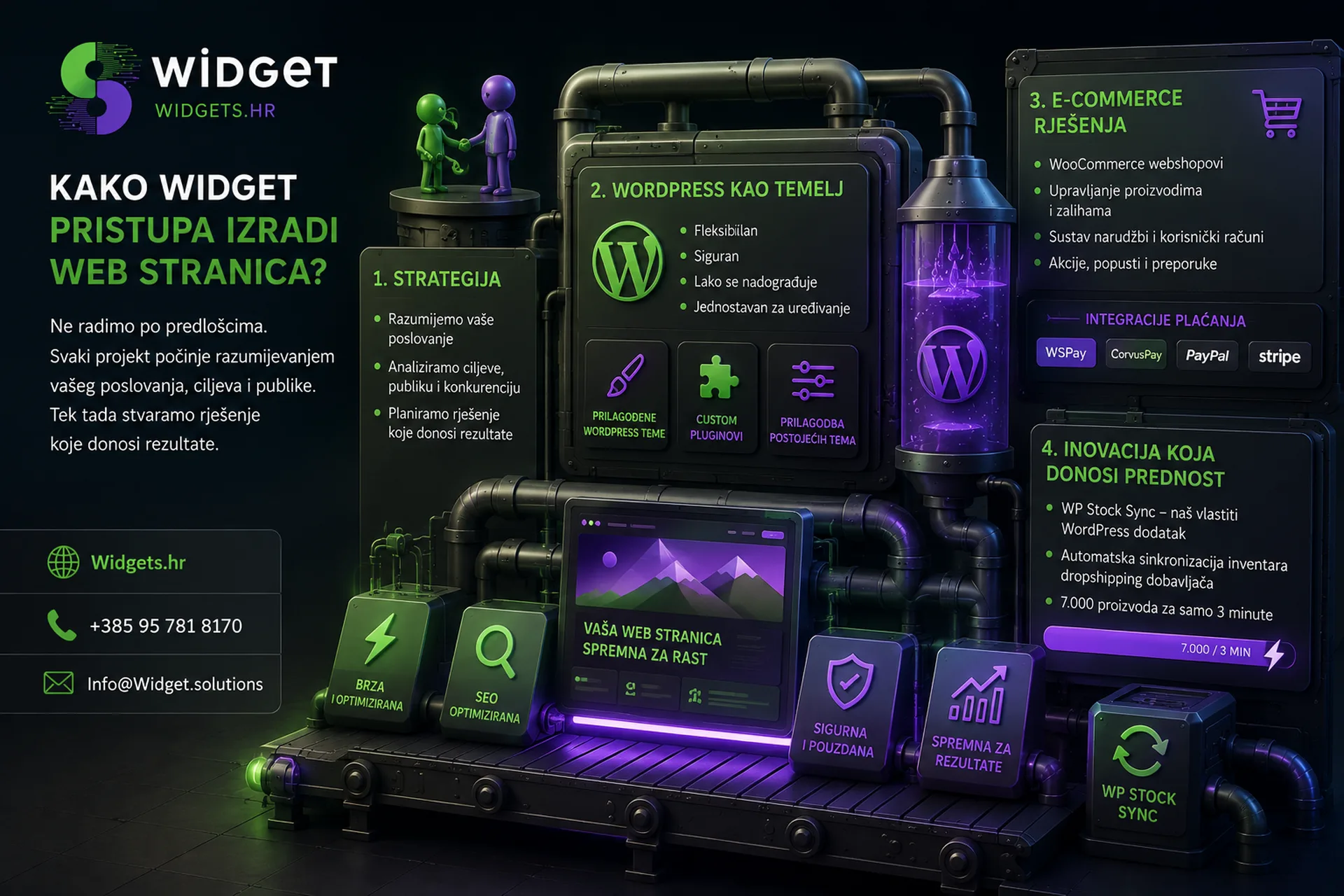
Our team uses WordPress as their primary platform because it offers the perfect balance between flexibility and manageability. We develop custom themes, custom plugins (including our own WP Stock Sync for dropshipping) and e-commerce solutions on WooCommerce. Every project goes through rigorous testing, speed optimization, and a safety check before launch.
We understand why coding is difficult, and that's why we offer our clients not only development, but also education, support and consulting every step of the way. Because a good website is not just a well-written code, it is a carefully designed business solution.
Coding is a living discipline that never stops growing
From punched cards to neural networks, coding has come an incredible way in just a few decades. It continues to develop, it continues to challenge, it continues to fascinate those who choose to enter this discipline. It's hard, it requires constant education and great precision, but it's also incredibly powerful. Every good programmer knows that behind every frustrating bug there is valuable experience.
And for anyone who wants to harness the power of well-written code for their business, without having to go through that learning curve themselves, Widget is here to help. Contact us and let's build together a digital presence that works for you.
Widget, one agency. All services. Zero stress.